China Top 10 Aisle Forklift Manufacturers in 2026?
Choosing an Aisle Forklift manufacturer in China requires more than comparing catalog prices. In 2026, warehouse operators face tighter aisles, taller racks, heavier pallets, and higher uptime expectations. This guide introduces ten leading Chinese manufacturers and explains why they deserve attention. The selection considers product range, engineering capability, factory experience, export performance, and after-sales support. Details matter.
We look beyond glossy brochures. We examine rated capacity, lift height, turning radius, battery options, mast visibility, controls, and operator protection. A 1.5-ton truck may perform well in a 2.4-meter aisle, yet struggle on uneven floors or during long shifts. Real purchasing decisions also depend on spare-parts access, technician response, training, warranty clarity, and documented quality procedures. Company information, product specifications, certifications, dealer networks, and customer-facing evidence should be checked against one another. Proof matters.
The ranking is practical, not absolute. Manufacturing strengths change, models evolve, and regional service quality can vary. Public information is sometimes incomplete; that limitation deserves honest mention. We encourage buyers to request live demonstrations, battery-duty calculations, load-chart verification, and references from comparable warehouses. A useful shortlist should survive those tests. It should match working realities, including cold storage, narrow rack beams, frequent pallet changes, or dust near loading doors. This article supports informed evaluation rather than promoting one supplier. Some readers may disagree with the order, and that is reasonable. The best choice is the manufacturer that consistently proves safety, performance, and support in your operation.
What Is an Aisle Forklift and Why Does China Matter in 2026?
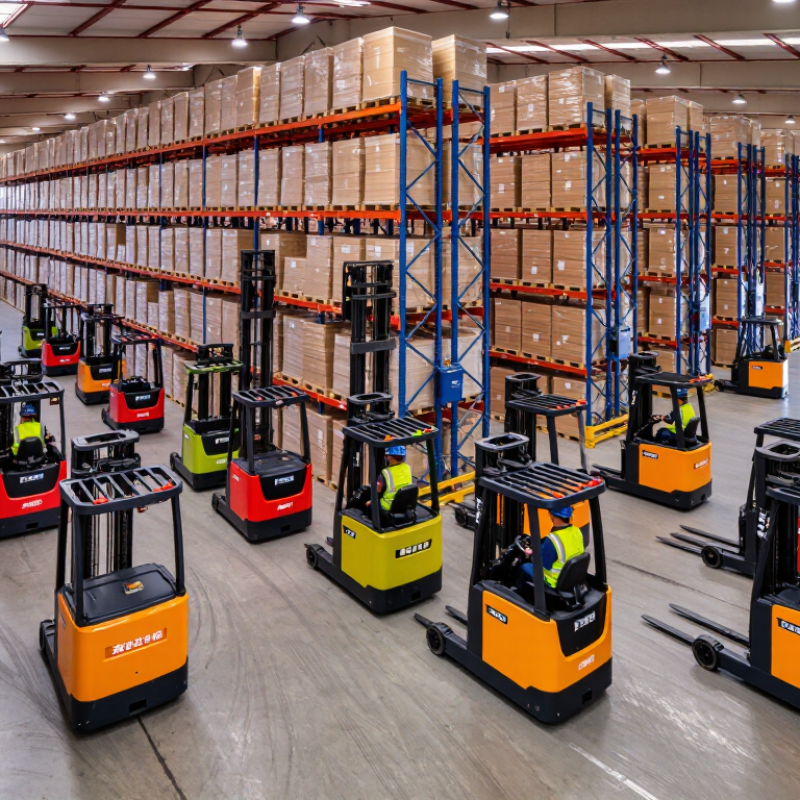
An aisle forklift is designed to work safely where ordinary counterbalance trucks cannot. It includes reach trucks, very-narrow-aisle machines, and order pickers. These models lift pallets in tight warehouse lanes, often above 10 metres. Their value is practical: more storage locations, shorter travel paths, and better use of expensive floor space.
China matters in 2026 because its manufacturing base supports the full equipment chain. This includes steel components, electronic controls, lithium batteries, sensors, and warehouse software. The World Industrial Truck Statistics report recorded more than two million industrial truck deliveries globally in 2023, showing the market’s large scale. China remains one of its most important production and consumption centres. The International Energy Agency also reported that China held over 80% of global battery cell manufacturing capacity in 2023. That advantage can reduce battery costs, though it does not guarantee better forklift performance.
Real warehouse experience reveals the difficult part. A narrow truck is useless if its turning radius, mast vibration, or charging schedule conflicts with daily operations. The word smart
is often overused. Operators still need clear sightlines, reliable braking, and simple maintenance access. Data from Interact Analysis shows continued growth in warehouse automation and mobile material-handling equipment, but adoption differs sharply by facility. A cold-storage site, an e-commerce warehouse, and a factory need different aisle solutions. Buyers should check aisle width, floor flatness, lift height, battery endurance, and local service capability before comparing China’s top manufacturers.
How the Top 10 Chinese Aisle Forklift Manufacturers Were Selected
Selecting China’s top 10 aisle forklift manufacturers for 2026 requires more than comparing advertised prices. The evaluation begins with practical evidence from warehouses, dealer interviews, product manuals, and public company records. Each manufacturer is reviewed against aisle width, turning radius, lift height, residual capacity, battery options, and operator visibility. Small details matter. A few centimeters can change warehouse productivity.
Field performance carries greater weight than polished brochures.
We examine uptime records, preventive maintenance procedures, spare-parts availability, technician response times, and warranty clarity. Independent safety documentation and export compliance records also support the assessment. Customer feedback is checked across different industries, including cold storage, retail distribution, and manufacturing. One impressive demonstration is not enough.
The final selection combines engineering capability, production consistency, service coverage, and total operating cost. We also consider whether a manufacturer can customize controls without weakening safety standards. Data from 2025 and early 2026 is prioritized, although regional information is not always complete. No ranking is flawless. Some customer claims are difficult to verify, and reported productivity may depend on operator training. That uncertainty is recorded rather than hidden. A reliable manufacturer should accept technical questions, provide measurable specifications, and show how its forklifts perform after months of daily use.
China’s Top 10 Aisle Forklift Manufacturers in 2026
China’s Top 10 Aisle Forklift Manufacturers in 2026 should be judged by measurable warehouse performance, not advertising claims. The shortlist should include Chinese producers with proven narrow-aisle designs, stable production, and documented service coverage. Key checks include residual capacity at height, turning radius, mast visibility, battery endurance, and braking response on polished floors.
The International Federation of Robotics reported 276,288 industrial robots installed in China during 2023, representing more than half of global installations. This investment reflects stronger automation demand inside distribution centers. Fortune Business Insights also identifies warehouse efficiency and electric equipment adoption as major forklift market drivers. For aisle forklifts, lithium battery systems, regenerative braking, and programmable travel speeds are becoming practical differentiators.
Field testing remains essential. A machine may claim a 1,500-kilogram capacity, yet its usable load can fall sharply above eight meters. That detail matters. Buyers should compare independent load charts, operator visibility, charging cycles, and maintenance records. Service response deserves equal attention; a stalled truck can block an entire aisle. The ranking is not perfect, because public data rarely separates aisle forklift sales from broader material-handling equipment. Careful readers should verify factory audits, warranty terms, and regional parts availability before signing a purchase agreement.
Key Differences in Products, Technology, and Industry Applications
China Top 10 Aisle Forklift Manufacturers in 2026?
Key Differences in Products, Technology, and Industry Applications
Comparing China’s leading aisle forklift manufacturers requires more than checking lifting capacity. Product architecture varies sharply. Counterbalanced electric trucks suit open warehouse lanes, while reach trucks perform better in narrow aisles and high-rack storage. In practical evaluations, buyers should measure turning radius, residual capacity, mast visibility, battery access, and cold-storage performance. Small differences become expensive during every shift.
Technology separates suppliers more clearly. Lithium-ion systems offer opportunity charging and reduced maintenance, but battery thermal management still deserves close inspection. Automation packages may include obstacle detection, fleet dispatching, remote diagnostics, and semi-autonomous navigation. The MHI Annual Industry Report 2024 reported that 55% of surveyed supply-chain professionals planned to increase technology investment. That figure supports stronger digital demand, though it does not prove every automated feature delivers a quick return.
Safety remains a commercial differentiator. The U.S. Occupational Safety and Health Administration links powered industrial trucks to about 35,000 serious injuries and 85 fatalities annually in the United States. Therefore, speed control, operator presence sensing, and pedestrian alerts need field validation. Application fit also matters: food warehouses prioritize hygiene and low-temperature reliability, while factories often value precise positioning and intensive duty cycles. WITS market data shows China remains the largest industrial-truck market by unit demand. However, international comparisons are not perfectly clean. Testing standards, duty cycles, and service conditions vary. A lower purchase price can still hide weaker uptime support.
China Top 10 Aisle Forklift Manufacturers in 2026
Key differences in products, technology, and industry applications: a non-brand product benchmark
Narrow-aisle reach and turret trucks provide the smallest operating aisles and the greatest lifting heights, making them suitable for high-density warehouses and automated storage systems. Electric counterbalance trucks are more flexible for general manufacturing and logistics, while stackers are better suited to light-duty warehouse operations. The figures represent typical published specification points for product categories available in China and are not company-specific data.
How to Choose the Right Chinese Aisle Forklift Manufacturer
Choosing the right Chinese aisle forklift manufacturer requires more than comparing catalog prices. Start with your warehouse conditions: aisle width, rack height, pallet size, floor quality, and daily operating hours. A forklift that turns well in a showroom may struggle between loaded racks.
Ask the manufacturer for measured data, not broad promises. Check rated capacity at your actual lift height, battery endurance, turning radius, mast visibility, and charging time. Request a live factory demonstration with a similar pallet. During a visit, inspect welding quality, hydraulic lines, battery compartments, and spare-parts storage. Small details often reveal production discipline.
Service support deserves equal attention. Confirm technician response times, remote diagnostics, operator training, and the availability of common parts in your region. Speak with current users if possible. Their experience with downtime may be more useful than polished sales material. Check quality records and applicable certifications, but do not treat paperwork as proof of every performance claim.
Test carefully.
A practical trial should run through several shifts, not only a short indoor display. Record steering accuracy, mast stability, noise, energy use, and operator fatigue. One mistake is choosing excessive capacity “for safety”; it can increase cost and reduce maneuverability. Another is ignoring local service capability. I have seen buyers focus on the lowest quotation, then face long delays for a simple sensor. Leave room for honest review after testing. The best manufacturer is not always the cheapest or largest, but the one that understands your workflow and supports it consistently.