

Top 10 Powder Sieve Machine Suppliers for Global Buyers
Choosing a Powder Sieve Machine supplier can affect product consistency, cleaning routines, and production uptime. A unit may look suitable in a catalogue, yet perform differently with your actual powder. Fine, damp, or easily compacted materials can change screening results. Small details matter: mesh size, contact parts, discharge design, and access for inspection. They deserve careful questions.
Quality expert W. Edwards Deming is widely associated with the reminder, “Quality is everyone’s responsibility.” For powder screening, that idea reaches beyond the machine itself. Buyers, operators, and suppliers all influence whether a sieve fits the process. A useful comparison should examine equipment range, customization, support, manufacturing experience, and clarity of technical information. Claims still need checking. Ask for specifications that match your material and capacity, not just a polished brochure.
This guide introduces ten suppliers serving global buyers and offers a practical starting point for evaluation. It is not a universal ranking; a strong choice for one plant may be wrong for another. And rankings have limits. Regional service, lead times, spare parts, and communication can matter as much as headline features. Compare carefully. Confirm the details. Then judge each supplier against your own process, budget, and operating conditions.
What Powder Sieve Machines Do and How They Are Classified
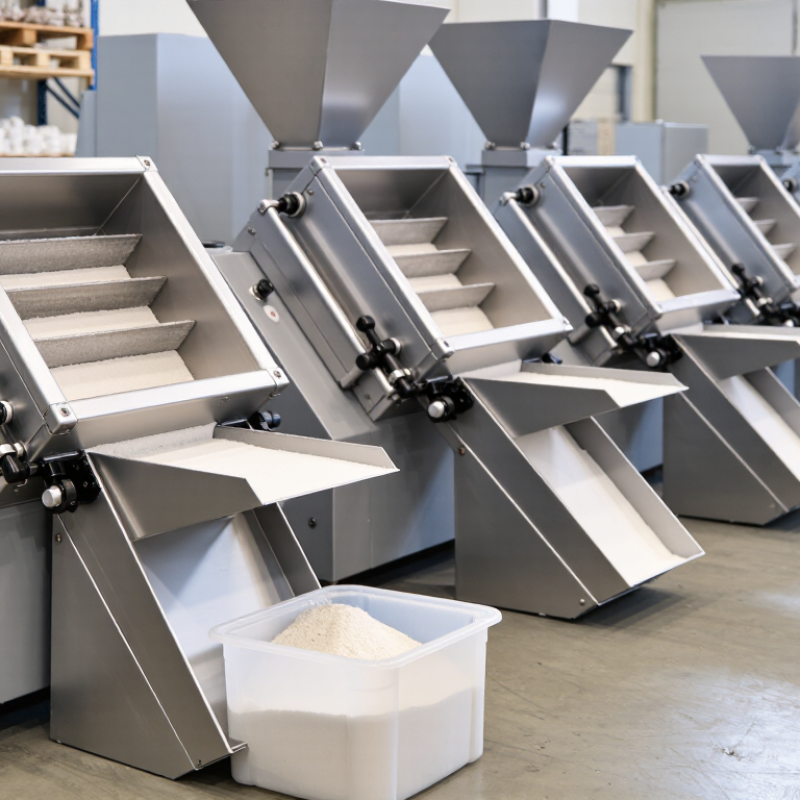
Powder sieve machines separate dry solids by particle size. A mesh deck retains oversized particles while finer material passes through. The same setup can remove lumps, protect downstream equipment, or produce a more consistent blend. Small details matter: a damp powder may blind the mesh, while a coarse screen may miss unwanted fines.
Machines are commonly classified by motion and separation method. Vibratory sifters shake material across a flat screen; gyratory units move it in a controlled circular path. Centrifugal sifters use a rotating rotor, while air-jet and ultrasonic systems help disperse fine or cohesive powders. ASTM E11-22 specifies test-sieve openings from 125 mm to 20 μm, giving buyers a useful reference for checking particle-size ranges. These are test-sieve specifications, not a guarantee of machine throughput.
Enclosure and dust collection also deserve attention. The U.S. Chemical Safety Board’s 2006 Combustible Dust Hazard Study recorded 281 dust incidents, 119 deaths, and 718 injuries in the United States from 1980 to 2005; these figures were not specific to sieving. Not every powder presents the same hazard, but a dusty discharge point can still complicate cleaning and sampling. I would compare screen access, seal design, and changeover time alongside capacity. Catalog figures alone can be misleading.
Key Criteria for Evaluating Powder Sieve Machine Suppliers
When comparing powder sieve machine suppliers, start with the material, not the catalogue. Particle size, moisture, bulk density, and target throughput all affect screening results. Ask for a test using a representative sample, and request data on capacity, separation accuracy, and screen life. A supplier should explain test conditions, not just quote a best-case figure. Small details matter.
Check whether the machine’s contact surfaces suit your powder and cleaning routine. Review screen replacement time, vibration control, noise, guarding, and inspection access. Confirm the offered voltage, installation footprint, spare-parts lead time, and commissioning support. Ask how performance changes when feed rate or moisture varies. A polished brochure is useful, but it cannot replace clear technical answers. Comparisons can still be imperfect: suppliers may test different samples or define efficiency differently. Ask them to state their assumptions in writing.
Tips: Send the same sample and operating targets to each supplier. Request a written test report listing mesh size, feed rate, and measured output. Check references from applications with similar powder behavior. If a claim sounds unusually precise, ask how it was measured.
Top 10 Powder Sieve Machine Suppliers for Global Buyers – Key Criteria for Evaluating Powder Sieve Machine Suppliers
Use this indicative scorecard to compare suppliers consistently. Suggested weightings are a buyer’s evaluation framework, not supplier performance claims.
| No. | Evaluation criterion | Suggested weight | What to assess | Evidence to request |
|---|---|---|---|---|
| 1 | Application and material fit | 16% | Whether the proposed machine suits the powder’s particle-size range, flow behavior, moisture sensitivity, bulk density, and process conditions. | A documented application review and a trial using a representative sample, where practical. |
| 2 | Screening performance | 15% | Expected throughput, separation efficiency, blinding risk, and ability to meet the specified cut size under defined test conditions. | Test results stating feed material, screen aperture, feed rate, operating settings, and acceptance criteria. |
| 3 | Screen configuration and range | 10% | Available screen sizes, deck arrangements, mesh or perforated-plate options, and suitability for the required separation stages. | Technical drawings, screen specifications, and confirmation of compatible replacement-screen options. |
| 4 | Hygienic design and cleanability | 10% | Product-contact materials, accessible surfaces, ease of disassembly, and cleaning approach for the intended industry and changeover frequency. | Material declarations, cleaning instructions, surface-finish details where specified, and inspection access information. |
| 5 | Containment and dust control | 10% | Sealing, connection points, and compatibility with the site’s dust extraction or contained-transfer system. | Interface drawings, sealing details, and a review against the buyer’s containment requirements. |
| 6 | Safety and compliance documentation | 10% | Documented machine safeguards and the ability to identify applicable local requirements, including hazardous-area considerations when relevant. | Risk assessment, manuals, declarations or certificates applicable to the destination and intended use. |
| 7 | Reliability and maintainability | 9% | Access to wear parts, inspection points, maintenance requirements, and the clarity of recommended service intervals. | Maintenance schedule, spare-parts list, service procedures, and warranty terms. |
| 8 | Controls and integration | 7% | Control options, electrical requirements, instrumentation, and compatibility with the buyer’s process-control and line interfaces. | Electrical drawings, control description, interface list, and stated utility requirements. |
| 9 | Delivery and project support | 7% | Clarity of project milestones, installation support, commissioning scope, training, and communication during delivery. | Written project schedule, scope of supply, installation responsibilities, and training plan. |
| 10 | Total cost of ownership | 6% | Purchase price alongside operating needs, screen replacement, maintenance, energy use, shipping, and expected service costs. | Itemized quotation, recommended spares, warranty coverage, and stated assumptions or exclusions. |
| Total suggested weighting | 100% | Adjust weights to match product, process, and destination requirements. | ||
How Global Buyers Can Assess Supplier Capabilities
When comparing powder sieve machine suppliers, look beyond catalog capacity and advertised mesh ranges. Ask how the machine handles your actual powder, including its flow, moisture, and tendency to form clumps. A short sample test can reveal blinding or uneven separation. Request the test conditions and results in writing.
Ask for drawings that show screen dimensions, product-contact materials, and cleaning access. Details matter. Confirm whether the stated output rate comes from a comparable material, not an easy-flowing test powder. For vibrating models, ask about adjustable frequency, vibration amplitude, and noise levels. These figures help you compare proposals on practical terms. They do not replace a production trial.
Check how the supplier supports installation, operator training, spare screens, and troubleshooting across your region. Ask for realistic delivery and service timelines. Ask for proof. A video of a running machine is useful, but it cannot confirm long-term reliability. Speak with a comparable user if possible, while recognizing that one reference may not match your process. Some suppliers may answer technical questions quickly but provide limited documentation; that gap deserves follow-up. Supplier assessment takes time. Keep a written record of assumptions, test results, and unresolved questions before making a decision.
Profiles of Ten Powder Sieve Machine Suppliers
A stainless-steel specialist may suit wet-cleaned lines, with polished contact surfaces and tool-free screen access. A compact-machine supplier serves pilot plants where floor space is tight. A high-capacity manufacturer focuses on broad decks and steady feed rates. An ultrasonic-screening supplier targets fine powders that blind ordinary mesh. Small details matter. A validation-oriented supplier provides documented test records and controlled settings for regulated production. These are distinct supplier profiles, not endorsements; buyers should confirm performance using their own material.
A food-processing supplier should explain how screens and seals are cleaned between batches. A mineral-processing supplier typically emphasizes reinforced frames and abrasion-resistant parts. An automation-focused supplier may integrate vibration controls, alarms, and enclosed dust collection. A custom-engineering supplier adapts inlets and outlets to awkward plant layouts. A service-led supplier is judged by spare-screen availability and technician response, not brochure claims.
Grand View Research estimated the broader industrial filtration market at about US$33.8 billion in 2023, with projected growth through 2030; this is adjacent-market context, not a powder-sieve sales figure.
Ask each candidate for mesh-size verification, throughput tests using your powder, and noise readings. A neat sample run is not proof. Results can shift with moisture, feed rate, and operator settings.
Comparing Suppliers for Different Purchasing Requirements
A shortlist of ten powder sieve machine suppliers is useful only when each is measured against the same purchasing needs. A fine, free-flowing powder behaves differently from a damp blend that clumps on the mesh. Ask suppliers to specify usable capacity, screen area, contact materials, and expected separation range. Small details matter. A polished catalogue rarely shows performance during a full production shift.
Request a trial with a representative sample, then compare throughput, screening accuracy, and residue left on the mesh. Check whether suppliers explain test conditions and provide results in a clear format. Ask how screens are changed and cleaned, and whether replacement parts are readily available. One supplier may offer a lower price but limited process guidance; another may cost more and help with installation. Neither is automatically the better choice.
Purchasing requirements also differ by site. A compact workshop may prioritize footprint and simple controls, while a larger facility may need continuous operation and integration with existing equipment. Confirm delivery scope, operator training, warranty terms, and service response times in writing. If a supplier cannot answer a practical question, note it rather than assuming the issue will disappear. That can feel cautious, perhaps overly so, but unclear support can become costly after delivery.
