

Who Are the Top Combination Wrench Manufacturers in China?
A Combination Wrench looks simple: one open jaw, one ring, and a steel handle. Yet small differences matter. A jaw that sits squarely on a hex fastener can reduce slipping; a rough finish may signal uneven production control. For buyers comparing Chinese manufacturers, the challenge is separating reliable capability from polished catalog claims.
Quality expert W. Edwards Deming is often associated with the principle, “Quality is everyone’s responsibility.” Applied to wrench production, that means examining more than the final polish. Forging consistency, heat treatment, dimensional checks, and batch traceability all deserve attention. A bright chrome surface is easy to notice. Internal process discipline is harder to see.
This overview introduces leading Chinese Combination Wrench manufacturers and the evidence buyers should weigh. It considers product range, manufacturing experience, inspection practices, customization, and export support. These factors can help narrow a supplier shortlist, but they do not replace sample testing or direct verification. Rankings also have limits; public information may be incomplete, and factory capabilities can change. A careful buyer should ask for current specifications, inspection records, and clear answers about materials and tolerances. The details matter. One overlooked measurement can turn a promising quote into a poor fit on the workshop floor.
What Combination Wrenches Are and Where They Are Used
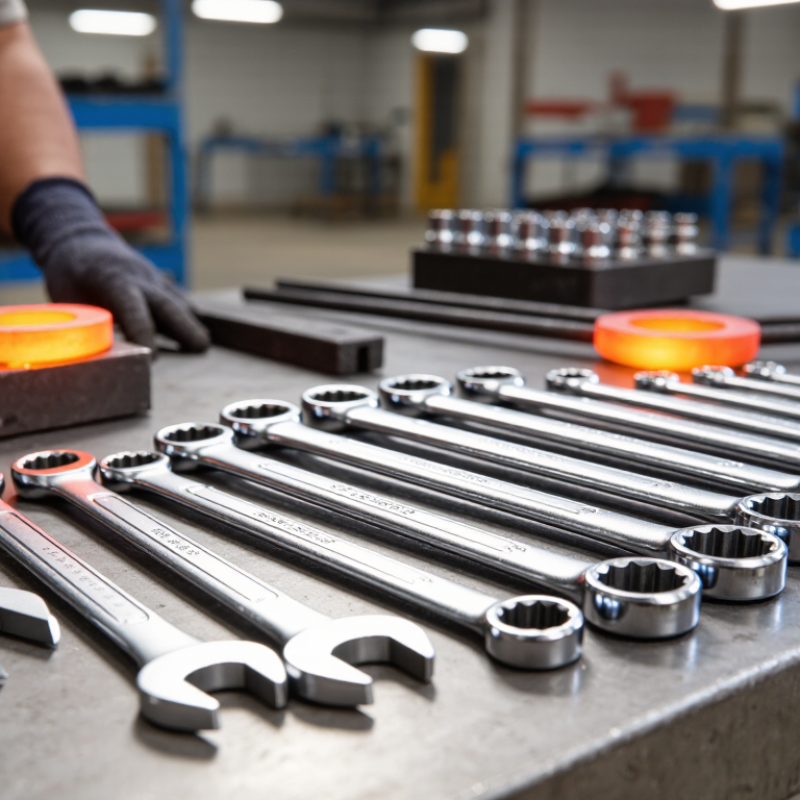
A combination wrench has an open jaw at one end and a closed box end at the other. Both ends usually fit the same size of nut or bolt. The open end slips on quickly, while the box end grips more sides of the fastener. This makes the tool useful for equipment assembly, vehicle maintenance, and household repairs. It is compact enough for a toolbox, yet sturdy models can handle many routine fastening jobs. Small details matter: a wrench that is slightly too large can round a nut’s corners.
Tips: Match the wrench size to the fastener before applying force. Keep the wrench square and fully seated. Pull steadily rather than jerking. If a bolt needs a precise tightening force, use a suitable torque wrench instead.
Combination wrenches work well where a socket and ratchet cannot fit easily, such as beside a bracket or inside a crowded engine compartment. The open end can help start a turn, then the box end can provide a firmer grip. Still, one wrench rarely solves every access problem. A nearby pipe or panel may block its swing, and forcing it can damage the fastener or your hand. Check the working space before choosing your tool.
How China’s Combination Wrench Manufacturing Industry Is Structured
China’s combination wrench industry includes large integrated factories, mid-sized exporters, and smaller specialist workshops. Their roles differ. Integrated plants may manage forging, heat treatment, machining, and finishing under one roof. Smaller suppliers often focus on one or two steps, such as polishing or packaging, and coordinate with partner factories.
Production usually begins with steel selection and hot forging. The wrench is then trimmed, heat-treated, machined at the jaw and ring, and finished with a plated or matte surface. Each stage affects fit and durability. A neat finish helps, but it cannot compensate for inaccurate jaw dimensions or inconsistent hardness. That detail matters.
Manufacturers serve different buyers through direct export, contract production, or trading and sourcing partners. Some offer custom sizes and private-label packaging; others concentrate on standard metric and imperial ranges. Quality systems also vary. Buyers can request material records, hardness results, dimensional checks, and samples from a production batch. A sample is useful, but it does not prove every shipment will match. That is an uncomfortable gap in supplier evaluation, and one worth checking through clear specifications and repeat inspections.
Which Chinese Manufacturers Are Recognized for Combination Wrenches
Who Are the Top Combination Wrench Manufacturers in China?
Chinese combination wrench manufacturers are recognized less by one universal ranking than by consistent production quality and technical capability. Established suppliers typically offer open-end and ring-end sizes, controlled heat treatment, and repeatable finishing. Look for clear specifications, such as wrench length, material, hardness, and dimensional tolerances. Those details matter when a tool must fit a fastener snugly, without rocking or slipping. Recognition varies by market and application.
Tips: Ask for sample wrenches before placing a large order. Check the jaw fit on a clean fastener, inspect the ring for smooth edges, and compare several pieces for consistent dimensions. Request material and hardness information, plus details about inspection procedures. A polished finish looks good, but it cannot prove strength by itself.
Supplier claims deserve a closer look. A factory may produce many tool types, yet its consistency across wrench sizes can differ. That picture is not perfectly tidy. Compare samples from different production batches when possible, and ask how defects are recorded and corrected. Clear answers, traceable quality checks, and realistic lead times are stronger signs of a dependable manufacturer than a broad catalog alone.
Common Metric Combination Wrench Sizes
The bars show nominal jaw-opening sizes in millimeters commonly found in metric combination wrench ranges. This is a size reference, not a manufacturer ranking; available sizes vary by product line.
How Leading Manufacturers Differ in Products and Capabilities
China’s combination-wrench manufacturers differ less by catalog size than by control of steel, geometry, and finishing. Grand View Research valued the global hand-tools market at USD 25.9 billion in 2023 and projected a 4.3% compound annual growth rate from 2024 to 2030. That growth raises the bar for consistent production, not just larger output. Buyers should compare steel specifications, heat-treatment records, and inspection methods alongside price.
Some factories focus on high-volume standard sizes, while others offer broader ranges, custom dimensions, or tighter control over jaw openings and ring alignment. Check whether samples show clean edges, smooth chrome plating, and consistent marking. Ask how hardness and dimensional checks are recorded across production batches. The details matter.
ISO 7738 provides dimensional guidance for combination wrenches, making standard conformity a useful point to verify with suppliers. Export experience can also indicate familiarity with documentation and repeat-order controls, but it does not prove quality by itself. A practical review might include a sample from more than one batch and a check of fit on common fasteners. Even then, one inspection cannot reveal every production weakness; that limitation deserves attention.
What Buyers Should Compare When Choosing a Manufacturer
When comparing combination wrench manufacturers in China, look beyond catalog photos and quoted prices. Ask what steel grade is used and how heat treatment is controlled. Request dimensional tolerances, hardness ranges, and inspection records for the wrench sizes you plan to buy. A polished catalog can still leave gaps. Check that the open end grips a standard fastener without rocking, and that the ring end fits cleanly into a tight space. Fit matters.
Tips: Request a production sample, not only a showroom piece. Test several sizes on real fasteners. Ask how defects are recorded and corrected. Small details count.
Compare quality systems, production capacity, and delivery consistency, but verify each claim with relevant documents or a sample order. Clarify whether inspection covers every unit or selected batches. Ask how surface finish is checked; uneven chrome or rough edges can affect handling and durability. Also review packaging, carton labeling, and the process for handling out-of-spec products. Communication is part of the comparison. Can the factory explain a tolerance clearly and respond with specific evidence? A low price may be useful, but it is not proof of value. No checklist catches everything, and I would still leave room for a trial order before committing to a large run.
