How to Choose the Right Photoelectric Sensors for Your Needs?
Choosing the right Photoelectric Sensors can significantly impact various industrial applications. These sensors are crucial in automation, providing reliable detection capabilities. According to a recent report by MarketsandMarkets, the photoelectric sensors market is projected to reach $3.2 billion by 2025. This growth highlights their importance in manufacturing and logistics.
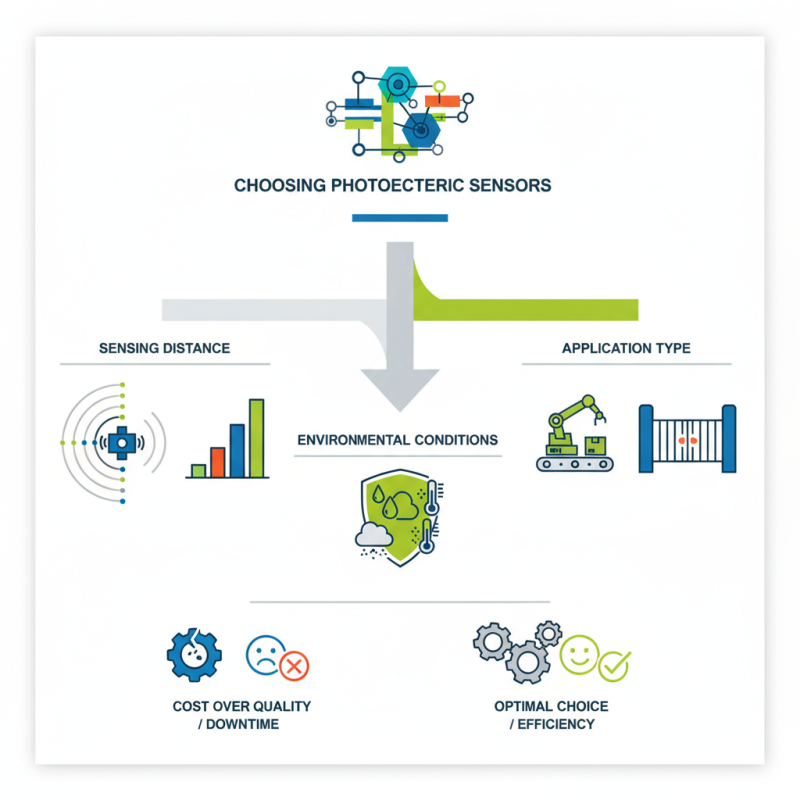
Expert John Smith, a renowned figure in the sensor industry, once stated, “Selecting the correct photoelectric sensor depends on understanding your specific environment and needs.” His insight underscores the complexity of choosing the right sensor. Factors like sensing distance, environmental conditions, and application type play vital roles in this selection process.
Often, buyers may prioritize cost over quality, which can lead to operational issues. Inadequate sensor choices may result in unexpected downtimes. Reflecting on the nuances of their requirements is essential. Understanding the parameters of photoelectric sensors can enhance operational efficiency and improve automation outcomes.
Understanding Photoelectric Sensors and Their Applications
Photoelectric sensors play a crucial role in various industries. These devices use light to detect objects. They are widely used in automation, packaging, and security systems. When choosing a photoelectric sensor, understanding their types is essential. There are three main types: through-beam, retro-reflective, and diffuse sensors. Each has unique features and applications.
Through-beam sensors offer a long detection range. They use a transmitter and receiver. If the beam is interrupted, the sensor triggers an action. Retro-reflective sensors bounce light off a reflector. They are convenient but can be sensitive to environmental changes. Diffuse sensors detect light from the object itself. They work best for shorter distances and flat surfaces.
Consider where the sensor will be used. Harsh environments may pose challenges. Dust and moisture can affect performance. Also, think about the required range and size. A sensor too large for the application might cause installation challenges. Choosing the right sensor can improve efficiency. Yet, errors can lead to costly downtime. Always assess specific needs before making a decision. Balancing versatility with precise functionality requires careful thought.
How to Choose the Right Photoelectric Sensors for Your Needs?
| Sensor Type | Detection Range | Application | Response Time | Environmental Resistance |
| Through-beam Sensor | Up to 15 meters | Conveyors, Safety Applications | < 1 ms | IP67 |
| Reflective Sensor | Up to 5 meters | Object Detection, Liquid Level | < 2 ms | IP65 |
| Diffuse Sensor | Up to 2 meters | Packaging, Assembly Lines | < 1.5 ms | IP54 |
| Laser Sensor | Up to 25 meters | High Precision, Distance Measurement | < 0.5 ms | IP67 |
Key Factors to Consider When Choosing Photoelectric Sensors
Choosing the right photoelectric sensors is essential for any automation process. Different applications require specific features and functionalities. Understanding these needs will lead you to the perfect sensor.
One key factor to consider is the type of sensing technology. Photoelectric sensors come in different types: diffuse, retro-reflective, and through-beam. Each type has its strengths.
Diffuse sensors are easy to install. They work well for short distances. Retro-reflective sensors can detect objects at greater distances. Through-beam sensors are best for precise detection over long distances.
Another important aspect is the
sensing range. Some applications may require sensors to detect at very close distances. Others might need sensors with a longer detection range. Look for a sensor that meets these specific distance requirements, but be careful not to over-specify. If a sensor is too sensitive, it might cause
false triggers in certain environments.
Tips: Be mindful of the environment. Dusty or wet conditions can affect sensor performance. Consider enclosure ratings as an important factor. Ensure the sensor's durability matches your setting. A poorly chosen sensor can lead to
malfunction and increased downtime.
Types of Photoelectric Sensors and Their Functionality
When choosing photoelectric sensors, understanding the different types is crucial. Photoelectric sensors generally fall into four categories: through-beam, retro-reflective, diffuse, and contrast sensors. Each type has unique applications. Through-beam sensors have two units separated by a distance. They emit and detect light beams. This works well for long-range detection.
Retro-reflective sensors use a mirror to reflect the beam back to the sensor. They are suitable for detecting objects without a clear line of sight. Diffuse sensors, on the other hand, detect objects based on light reflected from them. They are often used in shorter ranges. Each type has specific advantages and drawbacks, which may lead to confusion.
Choosing the right sensor often requires trial and error. An incorrectly selected sensor can lead to false readings or detection failures. It's essential to evaluate the environment where it will be used. Consider factors like dust, light interference, and object distance. Understanding the pros and cons of each sensor type is vital for optimal selection.
Evaluating Environmental Conditions for Sensor Selection
When selecting photoelectric sensors, environmental conditions are crucial. Different environments affect sensor performance. Consider factors like temperature, humidity, and potential contaminants. For instance, sensors in dusty areas may need special coatings to resist dirt.
Tips: Evaluate the installation site carefully. Check for extreme temperatures that can affect sensor accuracy. Some sensors may not function well in high humidity.
Lighting conditions are also important. Bright sunlight can interfere with sensor operation. In low light, sensors may need enhancement. Think about where the sensor is placed. Shadows might create blind spots.
Tips: Position sensors wisely to minimize interference. Test the sensors in real-world conditions before full implementation. Observing how they respond can reveal weaknesses. Always leave room for adjustments.
Cost vs. Performance: Making the Right Investment Choice
Choosing the right photoelectric sensor is crucial for many industries. Cost and performance are key factors that businesses must consider. Sometimes, lower-priced sensors fail to meet necessary performance standards. This can lead to costly downtime and inefficient operations. Accurate detection rates and response times matter more than just the initial purchase price.
Investing too heavily in high-end sensors without assessing real needs can be wasteful. Alternatively, opting for the cheapest option might compromise productivity. Customers often look for sensors that balance budget constraints and operational efficiency. Think about the specific environment where the sensor will be used. Factors like ambient light, dust, and temperature can impact sensor performance significantly.
Consider real-world applications when making choices. Some environments may require extra features that add to the cost, but they provide greater reliability. A short-term savings might lead to long-term expenses. Reflect on past experiences with sensors, too. Have cheaper options consistently underperformed or caused issues? Finding the right balance is not easy, but it is essential for successful operations.
Cost vs. Performance of Photoelectric Sensors