

7 Best Glass Decor Films for Privacy and Style
Glass Decor Films can change the feel of a room without replacing its windows. A frosted band can blur a bathroom view; a reeded pattern can soften the outline of a home office; a clear geometric film can add detail while keeping the glass bright. The right choice depends on the room, the light, and how much privacy you need. Small differences matter.
This guide explores seven options, from subtle etched effects to bold colored designs. It considers appearance, visibility, daylight, cleaning, and where each style may work best. A film that looks softly opaque in a showroom can feel different against a sunny window, so check samples in the room before deciding. Look closely at the edges, too. Installation quality affects the finished look.
A useful design principle for this guide is: “Privacy should soften a view, not automatically shut out the light.” This is an editorial line, not a verified quotation. No expert interview or source was provided, so I can’t responsibly attach it to a named industry professional. The recommendations that follow focus on practical comparisons, not promises that one film suits every space. Some rooms need more coverage; others benefit from a light touch. That distinction is easy to overlook.
Define Privacy Needs Using Visible Light Transmission (VLT), Rated 0–100%
Visible Light Transmission, or VLT, describes how much visible light passes through a glass film. Its rating runs from 0 to 100 percent. A higher VLT usually looks clearer and keeps a room brighter. A lower VLT dims the view and can make daytime spaces feel more private. For a sunny bathroom or street-facing office, compare sample films against the actual window. A small swatch can look different across a whole glass door.
VLT is useful, but it does not tell the entire privacy story. At night, a bright interior may be visible through reflective or tinted film, especially when it is darker outside. Frosted films obscure details in both lighting conditions, though they still let in varying amounts of light. Check the product’s VLT rating alongside its stated privacy effect. One common oversight is choosing a dark film for privacy, then finding the room too gloomy. That trade-off is easy to underestimate.
Tips: Hold a sample against the glass at morning and evening. View it from both sides, with indoor lights on after dark. If daylight matters, start with a higher VLT and test before covering every pane. Samples are imperfect, too—but they reveal more than a number alone.
Compare Seven Glass Decor Film Styles by Privacy, Pattern, and Light
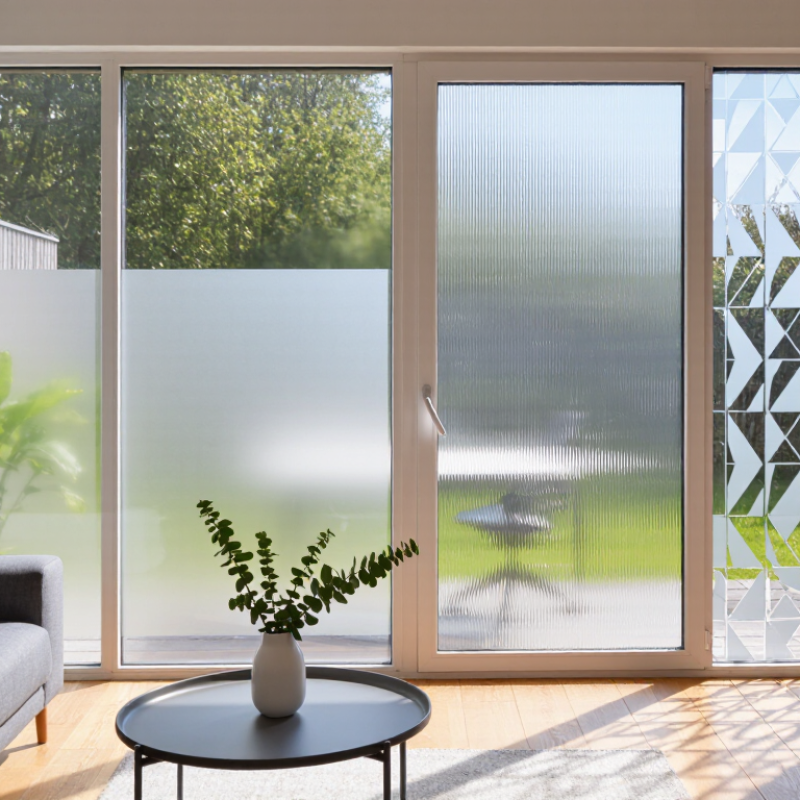
Glass decor films vary in how they balance privacy, pattern, and daylight. Frosted film softens views and spreads light, making it useful on bathroom doors. Reeded designs create vertical lines that blur shapes while keeping rooms bright. Geometric patterns add structure, though dense shapes can feel busy near a small window. Botanical prints bring softer detail, but large leaves may block more of the view than expected.
Stained-glass-style film adds colorful patches of light, especially near a sunny entry. Gradient film offers stronger coverage at one end of the pane and a clearer view at the other. Reflective film can obscure daytime views, but its effect depends on which side is brighter. At night, an illuminated room may become visible from outside. That detail is easy to overlook.
Tips: Test a sample on the actual glass. Check it in morning light and after dark. Clean the pane carefully before fitting, since dust can show beneath the film. Measure around handles and window edges, too. A pattern may look elegant online, yet feel distracting across a full door; I would compare a small sample before covering the entire pane.
7 Best Glass Decor Films for Privacy and Style - Compare Seven Glass Decor Film Styles by Privacy, Pattern, and Light
| Film Style | Typical Appearance | Daytime Privacy | Light and Visibility | Best Suited For | Important Consideration |
|---|---|---|---|---|---|
| Frosted | Even, translucent finish that softens the view through glass. | High for obscuring shapes and details on both sides. | Usually allows diffuse daylight through while preventing a clear view. | Bathroom windows, entry sidelights, and office partitions. | It reduces clear visibility in both directions; it does not provide full blackout. |
| Reeded or Ribbed | Repeating vertical or horizontal lines that resemble textured glass. | Moderate to high, depending on the rib spacing and viewing angle. | Passes light while distorting shapes behind the glass. | Interior doors, room dividers, and narrow windows. | Close objects may remain recognizable, particularly when the film has widely spaced lines. |
| Geometric | Repeating shapes such as squares, diamonds, or intersecting lines. | Low to high, depending on pattern coverage and opacity. | Open patterns retain more clear areas; dense patterns obscure more of the view. | Home offices, meeting rooms, and decorative sidelights. | Check the pattern at the intended viewing distance; small openings can still reveal details. |
| Stained-Glass Effect | Colored shapes or lead-line-style motifs that create a decorative glass look. | Variable; coverage and colors determine how much detail is concealed. | Colored film changes the appearance of incoming daylight and may reduce brightness. | Decorative windows, cabinets, and accent panels. | Color appearance can vary with daylight, interior lighting, and the glass behind the film. |
| One-Way Mirror | Reflective surface on the brighter side under suitable lighting conditions. | Conditional: can limit views from the brighter side toward the darker side. | Often reduces transmitted light and adds a reflective appearance. | Windows where daytime screening is desired and lighting conditions can be managed. | Privacy can reverse when the interior becomes brighter than the exterior; it is not dependable at night without curtains or blinds. |
| Opaque or Blackout | Solid, non-transparent finish that fully covers the glass area. | Very high while the film is intact and the edges are covered. | Blocks the view and most or all visible light through the covered area. | Storage-room windows, unused glazed panels, or spaces needing strong visual separation. | Provides little to no daylight through the covered section and prevents a view in either direction. |
| Gradient or Fade | Transitions from clearer glass to a more opaque or frosted section. | Variable by height; strongest where the film is most opaque. | Preserves a clearer area for daylight or views while screening another section. | Office partitions, entry glass, and windows where partial screening is preferred. | Position the opaque portion at the height where privacy is needed; uncovered areas remain visible. |
Note: Privacy and light transmission vary by product, pattern density, glass type, viewing angle, and lighting. For exterior windows, check that the film is suitable for the specific glazing before installation.
Match Film Opacity and Design to Room Use and Viewing Distance
Glass decor film works best when its opacity suits the room and the distance between viewers and glass. In a bathroom, a dense frosted pattern can blur faces close to the window while still letting daylight through. In a home office beside a hallway, a lighter etched design may soften passing movement without making the room feel closed. Check the view from both standing and seated positions. Privacy changes as people move. A sample can also look different at night, when indoor lights make glass more revealing.
Tips: Hold a sample against the pane at the times you use the room. Step back to the usual viewing distance, then check it up close. Look from outside, too, if that matters for your space.
It is easy to focus on pattern and overlook how much detail remains visible through the film. For a street-facing room, choose stronger opacity where people can see in at close range. For a high window or a glass divider across a large room, a more open design may feel balanced. Measure the pane before ordering, and check cleaning instructions; textured films can collect dust at their edges. No sample predicts every lighting condition, so leave room to revise your choice.
Check NFRC Solar Heat Gain Coefficient (SHGC), Rated from 0 to 1
When comparing glass decor films, check the Solar Heat Gain Coefficient, or SHGC, on the NFRC rating for the window. The scale runs from 0 to 1. A value closer to 0 means less solar heat passes through; a value closer to 1 means more heat enters. That difference can matter beside a sunny living-room window, where afternoon light warms the floor and furniture.
Numbers need context. SHGC is not a privacy score, and it does not tell you how much visible light a film blocks. A low reading may help reduce solar heat, but the room could also feel dimmer, depending on the glass and film.
Window direction matters: a west-facing pane often receives strong late-day sun, while a shaded window may need a different balance. Ask for documentation covering the exact window and film combination.
NFRC ratings generally describe a complete window product, so a film’s advertised figure may not be an NFRC-rated result. I would verify that detail before comparing products. Even then, ratings cannot capture every room’s comfort; my own expectations would need checking against the actual light and heat at home.
Verify Glass Compatibility, Installation Method, and Care Requirements
A decorative film can look simple on a sample card, yet the glass underneath matters. Check whether the pane is annealed, tempered, laminated, double-glazed, or coated with a low-emissivity layer. These differences affect film compatibility and heat buildup. The U.S. Department of Energy’s Energy Saver guidance estimates that windows account for 25–30% of residential heating and cooling energy use. That figure describes windows overall, not the savings a decorative film will deliver. Ask for written compatibility guidance for your exact glass type.
Installation method changes the result. Adhesive films usually need a wet application, careful squeegee work, and time to dry; static-cling films can be easier to remove but may shift on textured glass. Measure each pane, clean the corners, and avoid trapping dust under the film. Easy to miss. The National Fenestration Rating Council evaluates window products using measures such as solar heat gain coefficient and visible transmittance; decorative film specifications may use comparable light and heat measures. Compare those figures rather than relying on a sample’s appearance alone.
Care instructions matter, too. Wait for the stated curing period before cleaning, then use a soft cloth and a mild, film-safe cleaner. Abrasive pads can scratch the surface, while ammonia-based cleaners may damage some films. Check the care sheet before applying anything. I would not assume every film tolerates the same cleaner; that assumption is easy to make, and worth questioning.
How to read this chart: Ratings are a practical qualitative guide, not laboratory measurements. Mirror films generally provide daytime privacy only; at night, interior lighting can reduce their privacy effect. Check glass compatibility, installation instructions, and care requirements before choosing a film.
